Shuffle neighbouring pixels to roughen a transition or build irregular texture.
You will learn
- Choose Jumble
- Make the first action and inspect its result
- Compare local areas of 3 and 9 px
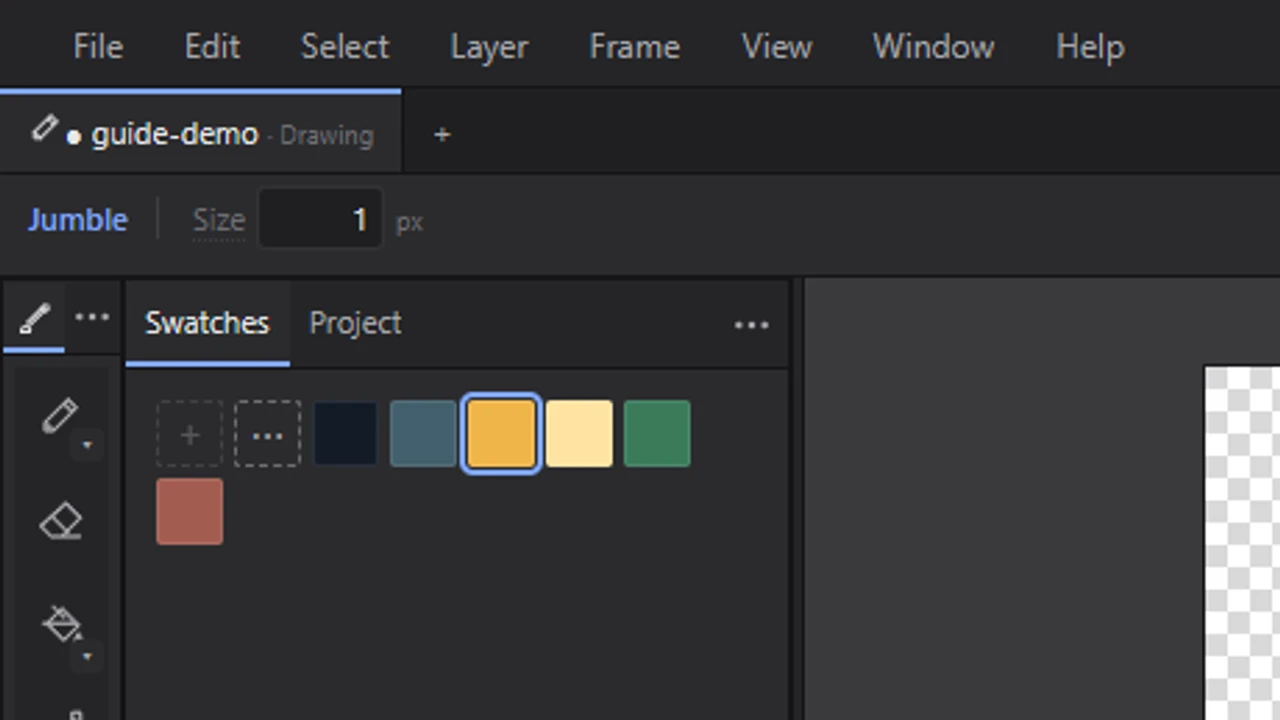
Choose Jumble
Find Retouch in the left toolbar. Open its arrow if it has one, then click Jumble. Check the tool name and its options before touching the canvas. Work on a visible, unlocked layer. On a phone, open the tool options sheet.
Check: Jumble is active.
Make the first action and inspect its result
Start with a dark-blue block touching a gold block. Choose Jumble and Size 9. Drag once down their shared edge. Existing colours exchange positions with nearby pixels, creating an irregular boundary. Unlike Blur, this does not calculate smooth intermediate colours. Inspect the enlarged edge after releasing.
Check: Move the pointer away and compare the result with the starting image.
Compare local areas of 3 and 9 px
Draw along the blue/gold boundary at Size 3. Undo and repeat at Size 9. A 1 px pass along one solid colour may have no different-coloured neighbour to exchange, so this comparison starts at 3. Both examples keep the same source image and only disturb nearby pixels.
Check: The wider footprint affects a broader local area.
Practise with a controlled second example
Select a small inner strip crossing the two colours. With Jumble at Size 9, make one downward pass and stop. Ctrl+D removes the boundary. Compare the irregular inner texture with the protected outer silhouette. Use short passes and Undo before adding more texture.
Check: Inspect the finished result with the pointer away.
Before you continue
Use Undo to compare the result with the original, then save when the change is useful. On a phone, open the tool options sheet when a control is not visible.
If something does not work
The result is not what I expected
This tool rearranges neighbouring colour structure; it is not a smooth mixing brush. Use Gradient or intentional colour steps for a controlled transition.