
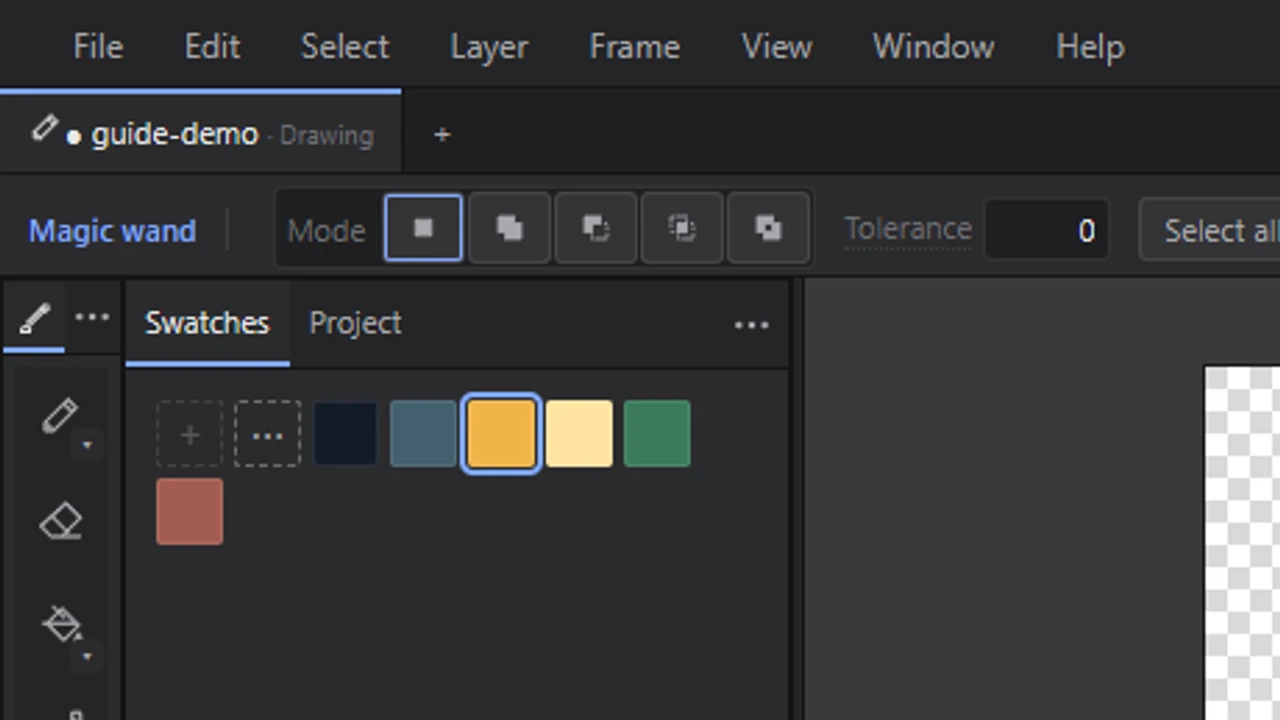
Select matching colours without manually tracing every pixel.
You will learn
- Find Magic wand
- Mark a region, then test its boundary
- Compare exact and nearby colours
Find Magic wand
Open the Selection arrow in the left toolbar and click Magic wand. Check the name in the options row. The selection mode buttons control how your next region combines with an existing mask. On a phone, open the tool options sheet.
Check: Magic wand is selected before marking a region.
Mark a region, then test its boundary
Start with two neighbouring gold shades and another separate gold block. Click the left gold region once at Tolerance 0 with Contiguous enabled. Only its exact connected colour is selected. Inspect the dotted boundary: no new paint exists yet. Choose Pencil, green and Size 9. Drag horizontally across both edges. The selected area accepts the stroke; the rest is protected.
Check: The green mark is clipped to the selection shape.
Compare exact and nearby colours
Set Tolerance to 0 and click or begin the stroke on a source colour. Undo, use 70 and repeat at the same point. Higher tolerance includes more similar colours; reduce it if neighbouring shades change unexpectedly.
Check: The higher tolerance can include a larger range of source colours.
Choose connected or separated regions
With Contiguous enabled, the operation starts at the clicked region and stays connected. Disable it to include matching pixels in separated areas. Compare from the same source pixel, then undo if the operation reaches an unintended object.
Check: Separated matching regions are eligible only when Contiguous is off.
Compare four ways to combine regions
Start each comparison with the same first mask. Here the first mask is a rectangle crossing part of the left gold block; Magic wand provides the second region by clicking that block. Choose Add, Subtract, Intersect or Exclude overlap before marking that second region. Paint the resulting mask green so its boundary is visible. Undo the paint, rebuild the first mask and compare the next mode. Ctrl+D removes the final selection.
Check: The green result shows exactly which region each mode keeps.
Cross the boundary without painting outside
Start with two neighbouring gold shades and another separate gold block. Click the left gold region once at Tolerance 0 with Contiguous enabled. Only its exact connected colour is selected. Keep the selection active. Choose Pencil, green and Size 9. Begin the stroke outside one edge, cross the selected area and finish outside the opposite edge. Only the inside receives paint. Press Ctrl+D; the boundary disappears and the clipped stroke remains.
Check: The outside remains untouched after deselecting.
Make a clipped stripe and a thinner highlight
Start with two neighbouring gold shades and another separate gold block. Click the left gold region once at Tolerance 0 with Contiguous enabled. Only its exact connected colour is selected. Choose Pencil, green and Size 9. Draw a horizontal stripe crossing the whole region. Change to pale yellow and Size 3, then make a second pass just above the first. Keep the mask active for both passes. Ctrl+D reveals the finished stripes without the dotted boundary.
Check: Both strokes stop at the same selected boundary.
Before you continue
Use Undo to compare the result with the original, then save when the change is useful. On a phone, open the tool options sheet when a control is not visible.
If something does not work
The result is not what I expected
A visible composite can differ from the active layer. Check the sampling option and the active layer before raising tolerance to compensate for the wrong source.